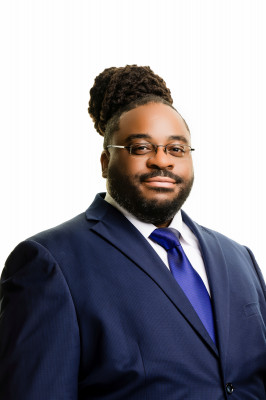

Photo of Jermaine Brown

We asked Jermaine Brown, a Trial Attorney in the Houston office of Wiley Wheeler, P.C., to provide his sincere answers to a range of questions.  After reading, you will be more more abreast with the understanding and competency that Mr. Brown brings.

1. Why did you start practicing labor and employment law? 

Employment is the foundation of social mobility. It is how people build lives, support families, and claim their place in our society. When an institution denies someone that opportunity or punishes them for asserting their rights, it strikes at their dignity. I practice employment law because my clients’ dignity at work matters.

2. Who is your favorite Supreme Court Justice?

John Marshall Harlan, the Great Dissenter, who stood alone in Plessy v. Ferguson and declared that the Constitution neither knows nor tolerates classes among citizens.

3. What do you think is the most important part of a good case? 

The client. Facts matter, evidence matters, but a good case starts with a client ready to assert their voice. When someone trusts you with their story, that's the foundation on which everything else is built.

4. If you could write a new law, what would it do?

The Workplace Sunlight Act. Justice Louis Brandeis was right: "Sunlight is the best disinfectant." The government already tracks which employers face discrimination charges, safety complaints, and labor violations—but keeps that information in the dark. This law would require federal and state agencies to publish information about certain employers. It would also require employers to disclose what the government does not see. Investors get disclosures before risking their money.

Workers deserve the same before risking their livelihoods. What grows in darkness cannot survive the light; only sunlight disinfects.

5. Besides Rob Wiley, P.C., what is the most interesting job that you have had?

College wrestling assistant coach. I worked with young athletes and learned that the real teaching happens off the mat. Wrestling teaches you how to get back up when someone takes you down. Life demands the same. 

6. How do you market yourself differently than others?

Every case has a story. Often, that story has been minimized, rewritten, or ignored entirely. Clients come in carrying a heavy burden—an experience that shaped them, that cost them, that no one took seriously. They have been talked over, written off, or quietly pushed out. Somewhere along the way, they started to wonder if they were the problem. They are not. The client lived it. They know what happened. Their story matters. It deserves to be acknowledged, protected, and championed. It deserves to be heard. I am here to listen. To protect. To advocate.

 7. What do you do when you're not practicing law?

Serving my community. Reading fiction and nonfiction books. Laughing with those who are dear to me.

8. How would you describe the color yellow to someone who could not see?

9. Yellow is the feeling of the sun rays landing on your face after days of gray. It does not ask permission. It just arrives. It is the warmth of someone sitting beside you in silence, asking for nothing, offering everything.

10. What's your favorite legal TV show?

Pro Bono, a Korean legal drama.


  1. If you could argue any case in history, what would it be?


Two cases. In Board of Education v. Rowley, I would argue that signed language is not merely an auxiliary aid or tool—it is a distinct language deserving the same constitutional protection in education that the Supreme Court recognized in Meyer v. Nebraska and Pierce v. Society of Sisters. A child deserves an education in her language—not just access, but belonging. In Buck v. Bell, the Supreme Court allowed the state to decide who was worthy of existence. That idea did not stay in that courtroom. It crossed an ocean and became the blueprint for atrocities. I would argue what should have been argued then—that no government has the right to decide who belongs. Carrie Buck's dignity was not the state's to erase.

Summary: Not every resignation is voluntary. When an employer makes working conditions so unbearable that a reasonable person would feel compelled to quit, the law may treat that resignation the same as a termination. This is called constructive discharge, and it could mean the difference between walking away with nothing and holding your employer accountable.

Summary: Courts have used the 50-year-old McDonnell Douglas framework to evaluate workplace discrimination and retaliation cases based on circumstantial evidence. Two Supreme Court Justices have called for it to be scrapped, and a new case in the Fifth Circuit could change how every discrimination lawsuit is litigated in Texas.

You gave a company years of